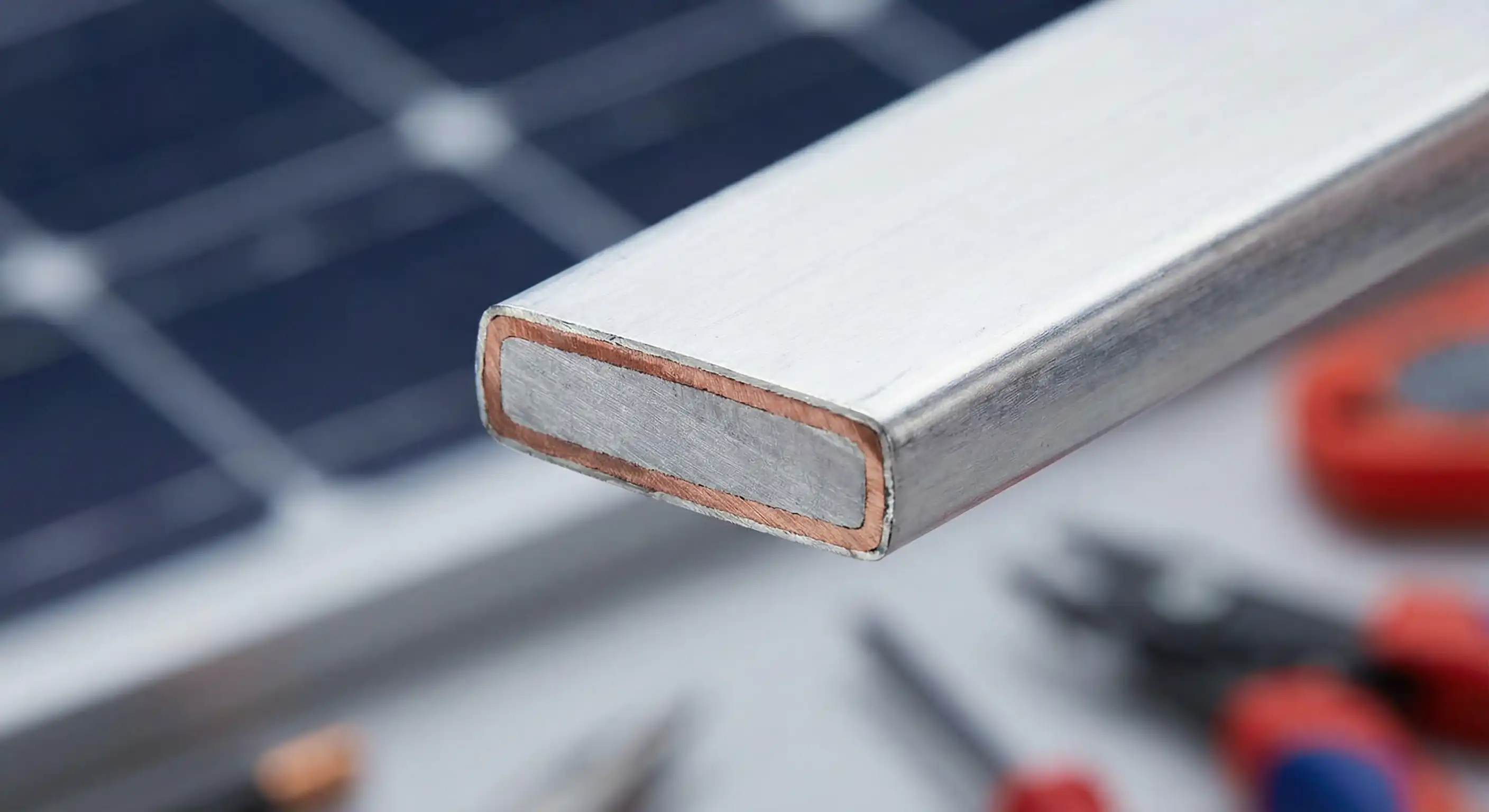
Rolling, slitting and dimensional control
RAYTRON MANUFACTURING PLATFORM
Copper-Aluminum Composite PV Ribbon & Precision Clad Conductors
Raytron manufactures composite PV ribbon, CCA, CCS and NCC conductors with precision rolling, clad bonding, annealing and surface treatment for solar, cable, EV, motor and energy applications.
Start qualification with
- Target product: PV ribbon, CCA, CCS or NCC.
- Key specs: width, thickness, diameter, coating or clad ratio, tolerance.
- Application limits: soldering, termination, bending, corrosion, thermal cycling or standards.
Supports samples, pilot lots and ongoing supply
Clad conductor, rolling and related processes
Suitable for engineering samples and trial orders
Our team will respond to your inquiry within 24 hours.
Quality system and lot traceability support
Core Product Pathways
Start with PV Ribbon / CCA / CCS / NCC
Composite PV Ribbon
For solar module interconnection, busbar collection and copper-saving module designs.
Key benefit: reduce copper usage while keeping solderable surfaces and a module qualification path.
CCA Conductors
For lightweight cable, high-frequency conductors, flat wire and foil evaluation.
Key benefit: balance conductivity, weight and cost with copper clad aluminum construction.
CCS Conductors
For grounding, coaxial cores, aerial conductors and strength-sensitive connections.
Key benefit: combine steel-core strength with copper-layer conductivity and corrosion resistance.
NCC Conductors
For battery connection, weldable surfaces, corrosion-resistant strip and foil evaluation.
Key benefit: nickel surface supports weldability, corrosion resistance and connection reliability validation.
Why Raytron
Help procurement and engineering decide faster
Quote-ready, downloadable and selection-oriented information helps buyers and engineers decide whether a material is worth validating.
Material to Qualification
Product form, key parameters, inspection items and application limits are connected in one selection path.
Clad Bonding & Precision Rolling
With 13 precision rolling lines, Raytron covers clad bonding, annealing, slitting, surface treatment and dimensional inspection.
RFQ-Focused Engineering Response
RFQ reply within 24 hours. Specification, application, sample, packaging and qualification needs can be reviewed quickly.
Application Pathways
Move from application to recommended materials and selection path
Solar PV
Recommended: composite PV ribbon, busbar ribbon, interconnect ribbon
Start with module layout, soldering process, target resistance and reliability tests.
EV
Recommended: CCA conductors, NCC strip or foil
Start with circuit class, termination method, bend needs and customer qualification requirements.
Battery
Recommended: NCC strip, NCC foil, copper or aluminum connection materials
Start with welding method, contact resistance, corrosion exposure and sample validation conditions.
Cable
Recommended: CCA round wire, CCS round or stranded wire
Start with frequency, span, strength, grounding or signal requirements.
Electronics
Recommended: precision foil, flat wire, small-size NCC or CCA materials
Start with thickness, width, tolerance, surface condition and assembly method.
Buyer Proof
Facts buyers can use before inquiry
Capacity
15,000 tons/year capacity, supporting samples, pilot lots and ongoing supply evaluation.
Quality
ISO 9001 quality system with RoHS / REACH documentation and inspection data support.
IP
28 patents across clad conductor, rolling and related process capabilities.
Need specs, samples or pricing?
Download the buyer kit or send product, specification, application and qualification requirements directly.
FAQ Preview
Frequently Asked Questions
Expert answers about bimetallic materials, manufacturing, and applications
What is bimetallic composite wire and why is it better than pure copper?
Bimetallic composite wire (e.g. Copper Clad Aluminum, CCA) is manufactured using our proprietary Clad & Weld technology, creating a true metallurgical bond between two metals. Compared to pure copper, CCA offers 30–40% weight reduction, up to 40% cost savings, while maintaining 62–70% IACS conductivity depending on copper ratio. It is widely used in EV motors, PV ribbon, battery tabs, and cables.
What is the difference between Clad & Weld and electroplating?
Clad & Weld creates a permanent metallurgical bond with bond strength ≥60 MPa, while electroplating merely deposits a thin surface layer. Our process is designed to resist peeling and delamination after validated bending and thermal cycling tests — making it suitable for demanding EV, aerospace, and energy storage applications.
What quality certifications does RAYTRON hold?
RAYTRON is certified to ISO 9001:2015 (Quality Management) and complies with RoHS and REACH regulations. We also meet ASTM international material standards and China National Standards (GB/T). Every batch is 100% electrically and mechanically tested.
What industries use RAYTRON bimetallic materials?
Our materials serve diverse industries: Electric Vehicles (motor windings, busbars), Photovoltaic Solar (PV ribbon, tabbing wire), Battery Energy Storage (battery tabs, connectors), Cable & Conductor, Electronics & Semiconductors, and Industrial Motors. 15,000 tons/year capacity, 13 precision rolling lines.
Send your specification to Raytron engineering
Share product form, dimensions, tolerance, application, annual volume, sample needs and target lead time. We will respond by product pathway.